Search

Amiah Kwanprayoon

Welcome to my world

The Tempest


BEETHOVEN (1770-1827) Piano Sonata No. 17 in D minor Op. 31 No. 2
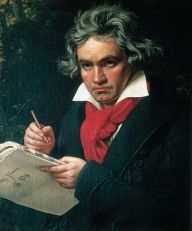
1310334-Ludwig_van_Beethoven

Beethoven’s 32 Piano Sonatas were divided into 3 styles by his level of deafness

Early Period Sonatas, Opus 2 – Opus 22 (Piano sonatas no.1 -11): Beethoven could hear everything clearly and his works were inspired by Haydn and Mozart.

Middle Period Sonatas, Opus 26 – Opus 90 (Piano sonatas no.12 -27):  Behrend argues that “Suffering, the agitated mind, the interior struggle of the soul, are openly and strongly expressed, as though imploring sympathy and understanding”.[1] During this period, Beethoven’s problem led to a difficult life from the tragic interiority which stimulated him to create many great works.

Late Period Sonatas, Opus 101 – Opus 111 (Piano sonatas no.28 -32): Complete deafness, he could not hear anything. The last five sonatas were sublime and clearly showed his notable talent. However Beethoven was melancholic and resigned from this impairment

[1] William Behrend, Ludwig van Beethoven’s pianoforte sonatas, trans. Ingeborg Lund (Suffolk: Richard Clay &son, LTD , 1927), 87.
 

3000

The Piano Sonata No. 17 in D Minor, Op. 31 No. 2

Beethoven wrote the piano sonata No. 17 in D minor Op. 31 No. 2 in 1801-1802 which was in the middle period and it consists of three sonata form movements.

  • Largo – Allegro
  • Adagio
  • Allegretto

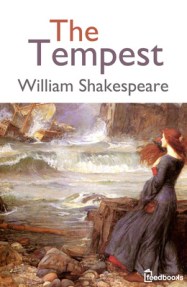
Behrend suggests that the nickname “THE TEMPEST” was claimed by Anton Schindler, a secretary of Beethoven because once he asked Beethoven about this work but he replied “Read Shakespeare’s tempest!”[2] The reading of Shakespeare’s dramas was what really inspired Beethoven to write his works. It can be seen that the first movement is very dramatic. It shows the expressive domain in the Largo (slow section) as Jones argues, “the openings of the exposition, development and recapitulation while the Sturm und Drang in the allegro section invokes the fear, terror and confusion”[3]. In fact, Beethoven wished to write “programme music” which he created many of his work from poetical idea. This concept did not work during his period; nevertheless, it bacame quite famous after his death and in the romantic period.

[2] William Behrend, Ludwig van Beethoven’s pianoforte sonatas, trans. Ingeborg Lund (Suffolk: Richard Clay &son, LTD , 1927), 89-90.

[3] Timothy Jones, Beethoven:The ‘Moonlight’ and other Sonatas Op. 27 and Op. 31 (Cambridge: Cambridge University Press, 1999), 103

The first movement – Largo – Allegro

Although a classical sonata form was normally written for the first movement, Beethoven added the Largo parts at the openings of the exposition, the development and the recapitulation. Expressively, Improvisation (Arpeggiated Chords), and long pedal indication with the dynamic pp were the main techniques. Meanwhile, there are dramatic characteristic in the Allegro which Beethoven used chromatic turn motives and the Sturm und Drang (Exciting, Terror, Confusion) with triplet harmonies.

The second movement – Adagio

This slow movement shows the calm and relaxed mood but it is still a sentimental movement. It is in the key of B-flat Major which is the sub-mediant of the D Minor. Sonata form appear in this movement, nevertheless, the development is replaced by a short transition passage. It can be clearly seen that double dotted quaver, demisemiquavers, Demisemiquaver triplets (a sense of Timpani) are the main motives. Moreover, practising this movement with a metronome can be a considerable method for steady rhythm.

The third movement – Allegretto

Returning to D minor key, this third movement presents a sublime sentiment while arpeggiated chords and semiquaver note figures run throughout the entire piece. The idea of this movement, Beethoven created very complicated harmony and reused previous material with a twist. For example, he reversed the motive from the exposition in the development and kept the arpeggio figures. To approach the performance is not only playing fast but also slowly to get a sense of the understanding of the music. Furthermore, pedaling needs to be significantly clear, therefore, analysing the chord progressions will lead to the effectiveness of using the piano pedal.


References

– Behrend, William. Ludwig van Beethoven’s Pianoforte Sonatas. London, 1927.

– Jones, Timothy. Beethoven : The ‘moonlight’ and other sonatas, op. 27 and op. 31. First published. Cambridge University Press, 1999.
Sonata in C minor Op. 5 No. 6 JC Bach & Rondo in A minor K. 511 Mozart

Rondo in A minor K. 511 – Wolfgang Amadeus Mozart

Rondo in A minor K. 511

Wolfgang Amadeus Mozart
Born: Salzburg, Austria, 1756; Died: Vienna, Austria 1791

Wolfgang Amadeus Mozart, the significant composer and musician of the classical period, he studied music with his father, Leopold Mozart who was also a successful composer. Wolfgang Amadeus Mozart had hundreds of compositions consist of symphonies, concertos, operas, sonatas, etc.

This Rondo opens with the dominant note of A minor followed by chromatic turn which Mozart carefully used throughout this music. Modulating to F major key in the first episode, he prepared the dominant of A minor to return to the rondo theme with more complication. In all piano music, Mozart always composed with one technique and in this work he fully presented chromatic element.

The American music theorist and musicologist Allen Forte described the Rondo in A minor as “Many musicians who have experienced this elegant and mysterious work seem to have acquired a special appreciation of the music.”

Sonata in C minor Op. 5 No. 6 – Johann Christian Bach

Sonata in C minor Op. 5 No. 6

Johann Christian Bach

Born: Leipzig, Germany, 1738; Died: London, England, 1782

  1. Grave
  2. Allegro moderato
  3. Allegretto

Johann Christian Bach was the youngest son of Johann Sebastian Bach. Moving to Berlin in 1750 after his father died, Bach studied composition and harpsichord with his brother, Carl Philipp Emanuel. In 1762, he migrated to England and spent his life with music works here.

The style of Johann Christian Bach was different from his father and his brother, he presented ideas between baroque and classical period. He had many instrumental works which each instrument was distinguished by one opus number e.g. six op. 5 sonatas for harpsichord or pianoforte. The form of Piano Sonata Op.5 was almost similar to sonata form in classical era. There is two to three movements in different styles but the last sonata in C minor could be the most beautiful and expressive.

The first movement which exactly shows melody and accompaniment starts with C minor chord followed by arpeggios. This magnificent Grave is a prelude; it does seem to introduce the fughetta in the second movement. Allegretto, the graceful last movement is a gavotte in rondo form.

The Different Approaches of the Performance between Glenn Gould and Angela Hewitt

Appearing commonly in baroque period, the early keyboard instruments such as harpsichord, clavichord and virginal were widely used for many music compositions. Nonetheless, after classical period, piano has become more important because it can make the sound louder or softer and more vibrate. Moreover, the mechanisms between piano and Baroque keyboards are not similar, so the technique of playing is also different.

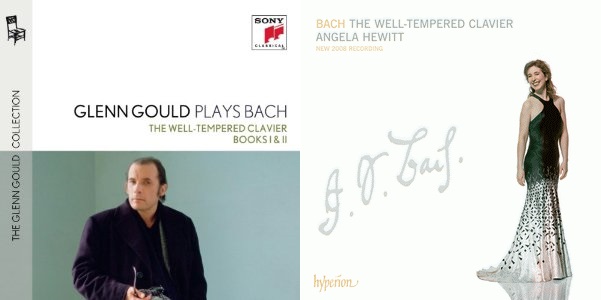
The question is how can we express and articulate the music in Baroque as the composers definitely did not write any dynamics or articulations? Although there are many ways to create the sound, musicians need to analyse and express by their own imagination and experience base on that period style. For example, the prelude and fugue No. 1 in C Major BWV 870, even Glen Gould and Angela Hewitt, both of them performed differently.

Glenn Gould was a Canadian pianist (25 September 1932 – 4 October 1982), he powerfully created the Baroque music style with very clear articulation. Even though he did not do noticeable dynamics, the sound in each voice came out completely distinct with polyphonic texture. In this fugue, he projected semi quavers throughout which leads the music to the true feeling of harpsichord sound. Furthermore, the tempo quite stayed the same except at the end. It would be reasonable to conclude that Baroque music can be truly perceived by the performance of Glenn Gould.

Nevertheless, music is not being strict and it can be more freedom. Angela Hewitt is a Canadian pianist, born on July 26, 1958; she also works on many Bach’s music. She shows a new style of playing Bach’s music in this century by playing expressively. In addition, making this prelude and fugue more interesting, Angela does a lot of dynamic directions and phrases every sentence emotionally. Her articulation is smoother than Gould but it is full of liveliness. Attractively, she takes time in each section of this fugue, so the structure is clearly divided.

It appears that there is no rule for playing music, seeing that the new generation of musicians creates baroque music as romantic style. However, it is necessary to explicitly understand the period and history because every single piece has their own origins. If musicians have enough experiences and reasons, there is no right or wrong of playing.

The Relationship between the Prelude and the Fugue

Bach: The Well-Tempered Clavier Book 2 – Prelude & Fugue No. 1 C Major BWV 870

Johann Sebastian Bach created the keyboard composition which is known as “The Well-Tempered Clavier” (WTC). It was formed of 2 books of preludes and fugues in 24 major and minor keys as in total of 48 preludes and fugues in order of 12 semitones from C to B. This essay will analyse the relationship between the Prelude & Fugue no. 1 in C Major BWV 870 WTC II. It is generally accepted that this music takes an important part in Bach’s work since it is the first composition of WTC II.

To begin with the prelude, it consists of four voices: soprano, alto, tenor and bass with an improvisation style. Grey claimed that “whereas the latter is in the nature of an improvisation upon a pattern figure which is rigorously maintained throughout, the present example is very much freer and subtler in form and procedure.”[1] Although in Baroque period, there was only basso continuo with a free creation of melody by music players, the preludes of Bach were written with flexibility structure. Furthermore, Grey said that the preludes in WTC II have many differences from the first set because they have a greater connection that will lead to the ensuring fugues[2]. For example, the subject in this prelude is involved around F instead of G which will certainly end with C, while the first preludes in WTC I have more independence of the fugues. Therefore, it can be argued that this prelude is truly an introduction of the Fugue.

On the other hand, the form of the fugue has a very formal structure. It is divided in 3 sections: an exposition, a development, and a recapitulation. Having 3 voices, the fugue in C major WTC II starts with the main theme “subject”, followed by counter-subject. Bruhn claims that “with its length of four bars, divided by a rest exactly in its middle, the subject of the C major fugue reveals a very regular phrase structure.”[3] In addition, the subject will be imitated in 3 different voices.

In conclusion, it can be seen that the prelude is essentially introducing to the fugue. It shows an idea of improvisation style relating to the fugue, while the fugue has a strict structure. Moreover, the tempo and the emotion between this prelude and fugue are also different. Being slower and more expressive, the prelude makes the fugue be more exciting.

References

1 Bruhn, Siglind (2003), ‘J.S. Bach’s Well-Tempered Clavier In-depth Analysis and Interpretation’, accessed Oct 6, 2015, http://www-personal.umich.edu/~siglind/wtc-ii-01.htm.

2 Gray, Cecil.The forty-eight Prelude and Fugue of J. S. Bach: Prelude and Fugue (three parts) in C major, Oxford, Oxford University Press, 1938.

[1] Cecil Gray, The forty-eight Prelude and Fugue of J. S. Bach: Prelude and Fugue (three parts) in C major (Oxford, Oxford University Press, 1938), 82.

[2] Ibid., General Observation, 80.

[3] Siglind Bruhn(2003), J.S. Bach’s Well-Tempered Clavier In-depth Analysis and Interpretation, accessed Oct 6, 2015, http://www-personal.umich.edu/~siglind/wtc-ii-01.htm.

Blog at WordPress.com.

Up ↑